Finding Your Readers: Practical and Slightly Unpredictable Ways Writers Get Discovered

Every writer—novelist, blogger, poet, essayist, or newsletter experimenter—faces one stubborn problem: readers don’t magically appear. They must be earned, invited, nudged, intrigued, and sometimes surprised into noticing you. Below is a purposeful guide to help you turn your craft into something sustainable.

Summary

You grow by building discoverable work, cross-pollinating your presence across surfaces, making your writing portable, creating memorable touchpoints, and treating visibility as an ongoing craft—just like the writing itself.

Traction Paths for Modern Writers

Discovery RouteWhat It DoesWhy It Works
Micro-publishing (e.g., short essays on platforms like Medium)Builds snackable entry pointsLow friction for new readers
Community guest appearances (podcasts, blogs, Q&A features)Injects your voice into someone else’s audienceBorrowed trust accelerates growth
Newsletter swapsExpands your ecosystemDirect, permission-based discovery
Releasing mini-guidesProves value upfrontShareable content attracts durable readers
Participating in genre-aligned forumsShows expertise naturallyOrganic fan acquisition

What Actually Helps Writers Get Found1. Write in Multiple Layers

Short, mid-length, and long pieces each attract different types of readers. A 200-word tip post may lead someone into your 80-page novella. A deep tutorial can get shared in circles you’ve never met. 

2. Tell People What Your Writing Stands For

Readers don’t follow generalists; they follow voices. Define what your writing is about in the first line of your bio. If your theme is “quiet rebellion” or “domestic magic,” say it plainly. 

3. Get Quoted, Even Informally

Whenever you answer questions on forums or contribute to community threads, you create micro-citations. These accumulate into ambient visibility. 

4. Collaborate With Complementary Creators

Essayists pair beautifully with photographers. Novelists with illustrators. Poets with musicians. Collisions create discovery.

5. Build Momentum With Smaller Wins

Tiny publications, guest spots, or niche newsletters count. They create a breadcrumb trail toward your bigger work. 

Creating a Visibility Routine

Use this once a week:

  1. Publish one small piece (a thread, tip, micro-essay).
  2. Resurface an older piece and share it in a new context.
  3. Comment in 2–3 communities where your genre lives.
  4. Pitch one collaboration (newsletter swap or joint piece).
  5. Make one intentional edit to your online presence—bio, website, pinned post, etc.
  6. Track what people respond to so you’re not guessing.

Leaving an Impression With Custom Business Cards

A surprising number of writers still land early fans through analog touchpoints. One of the most enduring tools? A standout business card that feels like an extension of your style. When you design custom cards that mirror your voice, you give people a reason to remember you long after the conversation ends.

If you want an easy way to create something polished, business card print options let you design and order custom printed cards with high-quality templates, generative, and intuitive editing tools—all in one place.

Product Spotlight

If you often lose track of drafts or inspiration scraps, the minimal distraction-free writing app Typora can be a quiet lifesaver. It’s markdown-based, clean, and ideal for writers who dislike clutter.

FAQs

Q: Is social media mandatory?
A: No, but discoverability requires surfaces. You can choose slow, quiet surfaces (blogs, communities, newsletters) if fast ones feel draining.

Q: How often should I publish?
A: Often enough that readers remember you exist. “Consistent irregularity” is fine—just avoid disappearing for years.

Q: Should I niche down?
A: Only enough that readers recognize a vibe or theme. There’s room for range once you have an audience.

Q: Does longform still work?
A: Absolutely—thoughtful depth travels well, especially via newsletters and curated reading lists.

Extras That Pull Readers In

  • A recurring series format
  • A one-sentence philosophy under your byline
  • Free mini-stories or chapter excerpts
  • Annotated versions of your own work
  • Behind-the-scenes thought dumps
  • Occasional, personal, “here’s-what’s-on-my-desk” notes

Conclusion

Being discovered is rarely a single moment—it’s a consistent pattern of showing up, shaping your voice, building memorable touchpoints, and making your work easy for readers to find. Treat visibility as a craft, not an accident, and you’ll build the kind of audience that fuels your writing life for years.

This article is written by Heather Kerns.
Our beloved’s departure was not a heavy rain, but a persistent humidity

Last April, when Dad was diagnosed with leukemia, and the doctor said it was a moderate type and most patients could live over ten years, my brothers and I felt relieved. I had just become an American citizen and started applying for my American passport and planned to go back to celebrate Chinese New Year. Due to COVID, I hadn’t been to China for over four years. I was sure my dad would recover, and I imagined inviting him to the U.S. to see where I live, what I was doing, and to meet my friends and family here–he had never been here yet.

However, things didn’t go as well as the doctor said, Dad’s condition grew worse and worse. He quickly lost weight; he couldn’t walk or sit for long, and what he experienced was pain. I then got my passport and started to apply for my Chinese visa, but it was delayed because the Chinese embassy required my naturalization certificate, which the passport center would send back to me eight weeks after I received my passport.

My dad was sent to the emergency room. I talked to the agent who helped me apply for a Chinese visa, asking if I could send the paper later. I called the passport center, begging them to send me my naturalization paper. I asked my dad to wait for me. The Chinese embassy refused my request, stating that my passport alone couldn’t prove I am an American citizen. The American passport center didn’t promise when they could send back my naturalization paper; they just asked me to wait patiently.

But my dad couldn’t wait. Twenty days after being discharged from the emergency room, Dad passed away at noon here, midnight in China. Until the moment my mom told me, “Your dad is gone,” I still couldn’t believe my dad would die. I cried in the video to my dad, “Why didn’t you wait for me? You didn’t wait for me because you don’t love me!” I had nowhere to vent my anger, sadness, and regret; I could only do it toward my dad’s body through the video.

My brothers and mother had been there with my dad when he was sick, when he passed, and during the five days of his funeral. The guests and the atmosphere at the funeral helped them accept the fact that Dad was gone. I hadn’t been there, and I couldn’t get over it. I couldn’t believe it.

Mostly, I felt guilty and regretful, which changed my attitude toward life. I became lazy and felt life was meaningless. When I reached some of my goals or received some surprises in life, work, or study, I felt empty because the one with whom I liked to share those feelings was not there anymore. In the poor, remote village where I was born and grew up, my dad was the first person who thought education was important for both girls and boys, and I was the first one to continue my education after middle school and become a teacher, which encouraged other parents to send their girls to high schools or vocational schools. He always supported me, whether I quit my teaching job and moved to a big city, decided to marry my husband, relocated to the US, or attend college here. Now, he is gone; he didn’t see my graduation, and he didn’t even meet my daughter in person.

I read books about death and wished my dad was somewhere in heaven looking at me. I kept his photos on my bookshelf and in my wallet. Wherever I went and whatever I did, I talked to his photo. This comforted me a bit. Thinking about Dad made my heart sink. I miss Dad so much. I unconsciously think of him while doing dishes, driving, watching a show, or even during writing. Many mornings when I woke up, especially when I dreamed of him, I felt that he was still here—talking, laughing, sitting, standing, in no pain, and asking me not to be tired and to maintain my health. I wish the time from last April was a dream, and if this could bring Dad back, I’d like to delete this period from my life, even longer, I wouldn’t mind. I am willing to.

Yu Hua, the famous Chinese writer, said, “Our beloved’s departure was not a heavy rain, but a persistent humidity. I am forever trapped in this dampness.” Dad has been gone for nine months, and I still can’t accept this truth. The guilt, regret, and grief haven’t faded a bit. I don’t know when I will feel better, or if I ever will for the rest of my life. At this moment, as I write these words, my heart is in pain, the same as the moment Mom told me Dad was gone. Oh, so hard!

Ying Tao is the Editorial Assistant of the North Pine County News. She can be reached at 320-384-6188 or circulation@hinckleynews.com

This is published in the North Pine County News on May 24, 2024.

Gao Named First Recipient of Harlequin Diverse Voices Scholarship

by David Ertischek

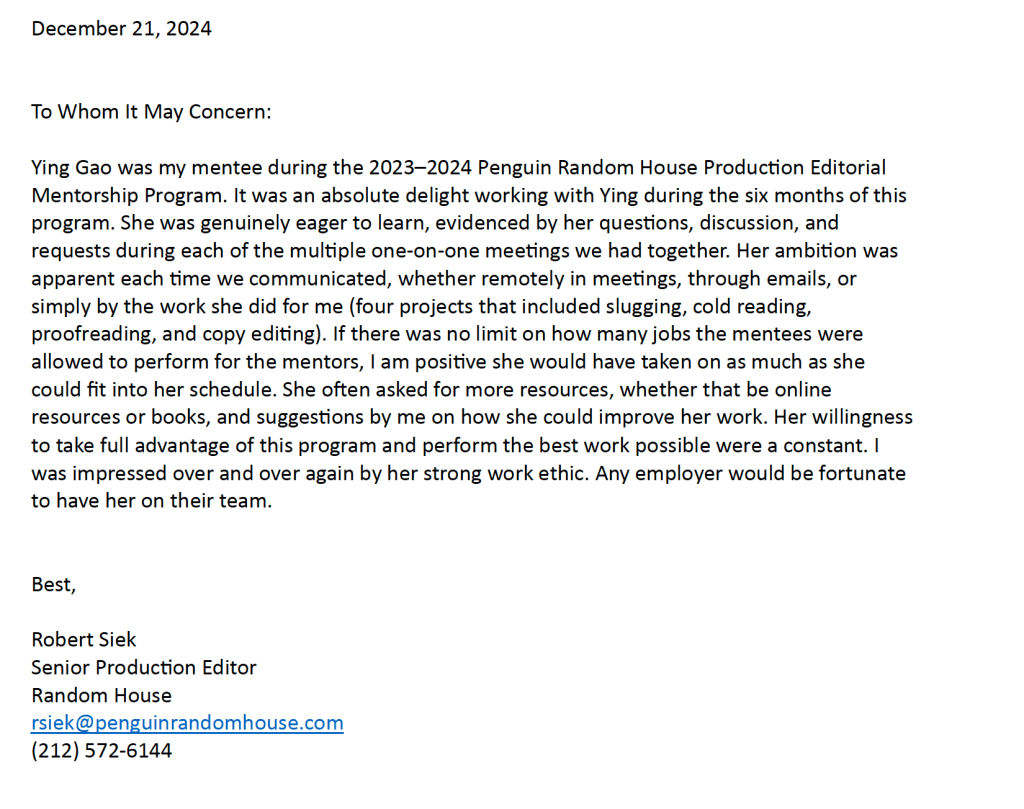
Ying Gao, MFA ’24 was very surprised upon learning that she was the first-ever Emerson College recipient of the Harlequin Diverse Voices Scholarship.

“It means a lot to me. English is not my native language. It’s kind of a challenge to write in English,” said Gao, who receives $2,000 thanks to the scholarship

Gao was a teacher before moving to the U.S. in 2014 from China, and has since written four novels in English, She now lives in Minnesota with her family, and recently graduated from the University of Minnesota at the age of 40.

Harlequin, a global publisher of romance, fiction, and nonfiction, created the scholarship this year for students enrolled in Emerson’s Popular Fiction graduate program. Scholarships are awarded by program faculty to students who bring diverse voices and stories to their writing and show exceptional talent and passion for a pursuing career in writing. 

“Emerson College is thrilled to have been selected as a Harlequin Diverse Voices Scholarship institution. We designed our MFA in Popular Fiction Writing and Publishing with inclusion in mind,” said Kim McLarin, Interim Dean of Graduate and Professional Studies. “Fully online and asynchronous, it can be completed in as little as five semesters and is more affordable than many comparable MFA degrees. As a result, diverse aspiring writers from all over the world have joined our community, where the joys and challenges of crafting high-quality romance, sci-fi, fantasy, mystery, thriller, horror and young adult fiction are celebrated.”

Faculty reviewed writing samples submitted with admissions applications, and then determined Gao was the one. One faculty member said, “Gao, in addition to being a fluid and compelling storyteller of great depth, best represents the goals and ideals of this scholarship.” 

The selection committee said, “In Ying Gao’s fiction the settings are vivid, the characters complex, the stakes high. Her voice is quietly penetrating, unafraid to dig into the dark spaces of the psyche and the heart in order to illuminate what it means to be human in this world. This is precisely the work of good fiction.” 

Gao enjoyed writing romance stories in Mandarin, but for English, she prefers to write on more serious topics such as women’s fiction.

“I want people to know how the bottom class feels, and stories of women from a lower class and low-income families,” said Gao. “It reflects something about ordinary people’s lives and how they struggle, and how they try to get what they want.”

Her submitted work is about a very poor undocumented girl in China whose father disowned her because she wasn’t a boy.

“Under this circumstance, she tries to get more education and try to find true love. But finds that love hurts and there are disappointments,” said Gao. “Her pursuit of true love goes badly – and she is just 15 years older than her son. She becomes crazy, her husband locked her in a room for two years, she went into a mental hospital, then goes in treatment and plans to open book store or go to college.”

Despite just starting weeks ago at Emerson, Gao can share how the program has already helped.

“I love it. This is what I want. Especially the writing workshop. I submitted two chapters and I got a lot of very, very helpful suggestions,” said Gao. “If I didn’t attend Emerson I don’t know if I could figure out the correct editing I need.”

Gao also believes that this scholarship is just the beginning of great things to come.

“I went to two people in my 20s to ask them about my future. And one said I’d be really rich at 27, it’s 13 years later since I was 27,” joked Gao. “I hope this scholarship will get me good luck to get my goal of being a published writer.”

CATEGORIES

News & Stories

TAGS

Graduate and Professional StudiesSchool of the ArtsStudentsWriting Literature and Publishing

This is published in Emerson Today.

Wandering Wonders: My Hilarious Evening at Wang Yujia’s Minnesota Orchestra Concert

Last year when I was looking for a job, I found a writer’s position opening at Minnesota Orchestra. As an admirer of the Minnesota Orchestra, imagining working with the musicians encouraged me to apply for the job. Therefore, I searched and watched videos on YouTube and got to know many conductors. With YouTube’s recommendation, I was led to a young conductor, and upon searching for his information, I got to know his girlfriend was from China, named Wang Yujia. That was my first time heard of Wang Yujia. 

About one month ago, the Chinese social media Xiaohongshu kept notifying me about Wang Yujia. Most of the information and comments were about how she wore provocatively in her show and very few comments about her professionalism. At the same time, Minnesota Orchestra’s newsletter informed that Wang Yujia would play with them in Minnesota. I decided to attend this concert, to reward myself for my hard work.

Because I purchased the ticket in late time and could only afford the cheapest one, I let the ticket system choose seats for me. When walked into the hall, I got to know that my seat was on the third floor. It was too far that I couldn’t see the mumian on the platform clearly. Worse was that there was a rail in front of me, I could only watch the player on the left platform between the bars of the rail. 

The old gentleman who sat by me was wise: he brought a pair of telescopes with him. As for me, I didn’t know classical music, even though I had taken a course on Music Appreciation in college, I couldn’t tell all the names of the instruments, no need to mention appreciating the music. But my neighbor was obviously an expert. He dressed in a vest. He echoed the rhymes with his hands, shoulders, and head. A satisfied smile hung on his face, the smile I have only seen on children who got their satisfied toys. After one piece of performance ended, he stood up, clapped the loudest, shouted “Oh–ho, whistled, and talked to himself, “Amazing, That’s amazing!” I asked him if he was a musician, and he said no, he plays a bit of Guitar. But he’s a fan of classic music. He said he was very excited about this concert because he had dreamed of these pieces of music to be performed. And today, Wang Yujia made his dream come true, and she made it so perfectly!

Wang Yujia wore a golden shinning short dress with tassels on the bottom. According to the audience on Xiaohongshu, she’s exposed her beautiful shoulders and back. She also wore high-heeled golden shoes. My neighbor said her heels were six inches high, and he also added, “You never know what she would wear until she shows up.” My neighbor is definitely Wang Yujia’s super fan! 

For Wang Yujia, “pianist” is not just a nametag for her. I am shocked at her performance. I wonder how that slim body can hold such strong strength. Her bending body and her fast-bounced fingers on the keys made her music powerful. The whole hall was quiet in listening to her! I think, only when a person spends their whole life working on one thing that is their passion can they reach such a high place.

After the concert ended, I went to my next step: looking for my parked car. I have no sense of direction. Without GPS, I can’t drive anywhere. But I was sure I could make it this time, because after parked my car, I took a photo of the parking number. But the aisles outside the concert hall were so alike, each one looked like the one I came in. I followed the biggest group of people turning right. Through the skyway, I got outside the door, but it didn’t look like the parking lot I parked my car. I walked upwards and, on the turning, I saw a young couple. The girl was from Asia––maybe because Wang Yujia was from China, I found many Asian audiences and heard many people speak Chinese. This couple seemed couldn’t find their car too. They kept going upward, I went down, along with the exit sign, and got out of the building. Standing by the street and trying to recall the road I drove through; I still couldn’t figure out the direction or which entrance I went in. And it was cold outside. I returned to the first floor of the building (it should be the Hilton Hotel), where I met the young couple again. The girl smiled at me. I said to them that I couldn’t find my car, and the young man said with an embarrassed smile, “Same here.” 

I quickly climbed the stairs and walked through the skyway. While walking, I thought that it was a punishment for I left my husband and two kids at home, and I was alone to enjoy the musical night. (The truth is my kids and husband don’t like orchestra). Returning to the concert hall, I found no one was there. Standing there and hesitating for a while, I turned left. Luckily, a young man in a black suit and carrying a black backpack showed up. I ran to him. Getting close, I noticed he just put on lip balm––he must be an exquisite person who loves life. I asked him if he knew the parking lot. He said yes, I showed him my parking picture, he said he also parked in that area, and I needed to walk backward. How fortunate, or I would miss it again and waste time! He pressed the elevator button and asked me if I was there for the concert, I said yes and asked him the same question, he said he belongs to the New York Orchestra. I walked too fast and was too tired to ask him what instrument he was playing. When the elevator reached level 2, he held the door open and pointed to the parking lot, saying my car must be in that area. Then he wished me good luck. What a kind man! I could only say thanks again and again.

As expected, I found my car in two minutes.

To a person like me who is weak in operational ability, driving a car is a big challenge to me, the most difficult work in my life. I had spent five years, taking two times in traffic rule test and four times on road test to get my driver’s license. Driving into the city is always a challenge too. Without any surprise, I exited the wrong way last night, and it took me another eight minutes to reach the parking lot. I followed the signs in the parking lot, but I didn’t know why and how I drove out of the parking lot! I had to make a turn and reenter the parking lot. It was full of cars. I finally found a narrow space by the wall pillar. I thought my small car (2019 Chevrolet Spark) could make it––I chose this style for easy parking. It was a left parking space. To be honest, I haven’t done much parallel or backing parking because places I had been had wide parking lots. I started making a left turn a little bit early and then my car side hit the wall. I heard the scratching sound. I couldn’t make a reserve but to move forward and parked it awkwardly. 

The light was dim last night, plus, I was in a hurry, so I didn’t pay more attention to the scratching. This morning when I checked my car. Oh my god, it was a big scratching and dent, right under the door. It reminded me of my dream one day ago: I dreamed that my nose was bleeding. I checked online the next morning, and it said, I needed to be careful because that meant bad luck and accidents may happen. I thought the scratch was the bad luck. Luckily, it was a small accident, and I didn’t hurt myself or other people or hit another’s car. I am a guru in persuading and comforting myself!

Suppose my dream would tell me this accident would happen, but I still would come to the concert. Art is a magic thing: it can help people build new, beautiful scenes. As for me, a drawing, a photo, a song, a piece of rhythm, a video, or even the views outside of my car window can make me think about my beautiful time in my youth and imagine beautiful future scenes. No need to mention this was an over two-hour concert. The music, performance, lights, and setting together create a brand-new world for me. Engaged in it, I felt peaceful, harmonious, romantic, and warm. At least, in those two hours, I have temporally forgotten my struggles and unhappiness in real life. I have regained confidence in life and re-established my hope. 

This is published in the North Pine County News on April 3, 2024.

How to Nurture Lifelong Healthy Habits in Your Kids

Helping kids grow into healthy adults isn’t about enforcing strict rules or obsessing over perfection. It’s about steady influence, quiet modeling, and the little conversations that add up over years. Children don’t just need advice — they need a roadmap they can actually follow. And as a parent, you’re the one drawing that map, whether you realize it or not.

Make Food Choices That Matter

Helping your kids understand the value of nutrition starts with showing them that what they eat fuels how they feel. When they reach for a snack, guide them toward options that nourish — like a crisp apple, a handful of almonds, or a smoothie blended with real fruit. These small choices shape their relationship with food over time, showing them that eating well isn’t about restriction, but about feeling strong, focused, and energized. The goal isn’t perfection, but consistency — and the more you normalize those decisions, the more second nature they become.

Lead by Example

You can’t expect your kids to eat vegetables or prioritize sleep if you’re constantly skipping meals and running on four hours of rest. They pay more attention to what you do than what you say, even if they act like they’re ignoring you. If health is something you model consistently — whether it’s making time for walks, drinking water, or just slowing down when you’re stressed — it becomes part of the atmosphere they grow up in. Over time, those habits become background noise for them, something familiar and normalized.

Create Posters That Inspire

Sometimes the simplest way to encourage healthy habits is by turning your walls into gentle, colorful reminders. Designing posters with uplifting messages about nourishing food, joyful movement, and taking care of the body can spark positive conversations and reinforce what you’re modeling at home. Let your child help choose the quotes or colors so it feels personal and empowering rather than preachy. Using a free online printable poster maker to stand out, you can easily design, customize, and print high-quality posters with ready-made templates and intuitive editing tools.

Ensure Wellness Is Part of Everyday Conversation

Kids don’t need lectures about cholesterol and glucose levels, but they do benefit from hearing why you do what you do. Whether you’re choosing a snack, moving your body, or deciding to go to bed earlier, saying those reasons out loud helps frame healthy habits as intentional. Instead of a monologue, create space for their curiosity and ideas. When they ask why you’re eating a salad or going for a run, answer with honesty, not pressure — that’s how you plant the seeds of self-awareness.

Let Movement Be Joyful, Not Punishment

Physical activity shouldn’t feel like a consequence for something they ate or a task they have to tick off. When movement is tied to play, fun, and family time, kids develop a lasting association with it. Dance in the living room. Walk to the store. Shoot hoops after dinner. It doesn’t need to be structured to be impactful — it just needs to be something they enjoy enough to carry with them into adulthood.

Encourage Sleep Without Making It a Battle

Sleep hygiene is one of those underrated areas that parents often overlook — or treat as a nightly showdown. Instead of fighting about bedtime, focus on creating rituals that make rest feel like a reward, not a punishment. Dimming lights, reading together, and creating a peaceful room environment can quietly cue their bodies to wind down. As they grow, that sense of rhythm can help them protect their own sleep without you needing to enforce it.

Foster Emotional Health as Much as Physical

Helping kids develop the tools to understand and express their emotions is as vital as teaching them to brush their teeth. Emotional well-being plays a huge role in physical health, and it’s your job to make sure they have room to feel, reflect, and regulate. You don’t need to solve every meltdown or force positivity — you just need to show that emotions are welcome and manageable. When children know they won’t be judged or dismissed, they’re more likely to open up, ask for help, and manage stress without destructive habits.

Teach Them to Think, Not Obey

Perhaps the most underrated skill you can give your child is critical thinking. Instead of simply telling them what to do, involve them in choices. Ask questions like “What would feel good to your body right now?” or “How did that meal make you feel afterward?” By making them active participants instead of passive followers, you give them the tools to make decisions long after you’re no longer right beside them. That confidence builds independence — and with it, healthier long-term choices.

Healthy kids don’t come from perfectly structured schedules or clean eating spreadsheets — they grow from connection, modeling, and small wins that build over time. As a parent, your presence and participation matter more than any Pinterest-worthy meal plan or chore chart. Show them what care looks like in the everyday: eating with intention, moving because it feels good, talking about feelings, getting sleep, and making room for joy. That’s what sticks — not the rules, but the rhythm.

This article is written by Heather Kerns.